When homeowners think about a garage door, they usually think about curb appeal, security, and price. But behind every garage door panel, every spring, every hinge, and every track system, there’s something most people never see: the global supply chain.
And right now, supply chains matter more than ever.
From steel production to hardware manufacturing and factory assembly, garage doors are built with materials and labor sourced across multiple regions—sometimes with strong standards, sometimes with very little oversight. That’s why the fair trade mindset is becoming increasingly important, even in industries people rarely associate with ethical sourcing.
Fair trade isn’t only about coffee and chocolate anymore. It’s about building a global economy where workers are treated with dignity, paid a living wage, and protected from unsafe environments—while also improving sustainability and long-term quality.
And yes… it belongs in garage doors too.
What “Fair Trade” Really Means (And Why It Applies to Garage Doors)
Fair trade is built on a simple idea:
People deserve fair treatment for the work that powers the world.
That means workers should have:
Safe working conditions
Respectful treatment
Fair pay (a living wage, not just minimum wage)
The right to organize and advocate for their rights
Protection against exploitative labor practices
A healthy community and environment surrounding production
In a product-based industry like garage doors, these values can impact everything from how raw materials are sourced to how parts are assembled and shipped.
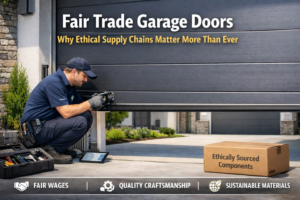
The Garage Door Supply Chain: More Global Than You Think
Even a standard residential garage door may involve:
Steel or aluminum panels sourced from one region
Insulation materials produced somewhere else
Hardware and springs made in separate facilities
Paints, coatings, seals, and adhesives from chemical suppliers
Final assembly from a manufacturer using outsourced parts
This means one garage door can touch many hands before it reaches your home.
And where the system is complicated, accountability becomes harder.
That’s where ethical supply chains—and fair trade principles—start to matter.
Why Ethical Supply Chains Matter More Than Ever in 2026
In recent years, homeowners have faced:
Rising costs of materials and shipping
Shortages of parts like springs, rollers, and motors
Delays due to global disruptions
Price competition forcing cheaper production
More counterfeit or low-quality components entering the market
When the industry becomes pressured by speed and cost, it becomes easier for companies to cut corners:
Cheaper materials
Lower safety standards
Unfair wages
Unethical outsourcing
The result isn’t only a moral issue. It becomes a quality and safety issue.
How Unethical Sourcing Can Affect Garage Door Quality and Safety
A garage door is not a decorative feature—it’s a heavy moving system that can become dangerous if parts fail.
Unethical supply chains often correlate with:
Low-grade steel that bends faster
Weak springs with short cycle life
Cheap rollers that wear out quickly
Substandard cables or brackets
Poor weather seals that crack early
Inconsistent manufacturing tolerances
And when garage door parts fail, the risks are real:
A door can slam shut unexpectedly
Tracks can warp or break
Springs can snap under tension
Openers can strain and burn out faster
Fair trade and ethical production may not guarantee perfection—but they usually support better consistency, safer labor, and improved engineering standards.
The Environmental Side: Sustainable Garage Doors Start at the Source
Fair trade isn’t only about workers—it’s also about the planet.
Ethical supply chains often prioritize:
Responsible material sourcing
Reduced waste during manufacturing
Lower emissions practices
Better chemical handling and disposal
Longer-lasting products that reduce replacement demand
That matters because manufacturing heavy materials like steel and aluminum has an environmental footprint.
So choosing a garage door that lasts longer and performs better isn’t just good for your home—it reduces total waste across the entire product lifecycle.
What Homeowners Can Look for When Buying a Garage Door
You don’t need to become a supply chain expert to make a smarter choice. Start with small signals that a company is operating responsibly:
Transparent product sourcing
Brands that share where materials come from tend to be more accountable.
Certifications or standards
Look for quality and sustainability standards—not just marketing claims.
Longer warranties
A company that trusts its product often isn’t using cheap components.
Local service partners
Strong local installers and repair teams usually refuse low-grade products because they don’t want warranty callbacks.
Repair-first mindset
Ethical businesses focus on fixing what can be fixed, not pushing replacements unnecessarily.
How Garage Door Repair Companies Can Support Fair Trade Values
Fair trade values aren’t only for manufacturers. Repair businesses have influence too.
A garage door repair South Gate, CA company supports ethical practices when it:
Uses high-quality parts with reliable sourcing
Pays technicians fairly and trains them properly
Avoids “pressure sales” tactics on homeowners
Educates customers instead of confusing them
Offers repair options before replacement
Encourages long-term safety inspections
When companies treat both workers and customers with respect, trust becomes their strongest marketing tool.
Fair Trade Isn’t a Trend—It’s the Future of Home Services
Homeowners are changing.
Today, people care about:
How their money impacts workers
Whether products are built to last
Sustainability and waste reduction
Integrity and transparency in pricing
Local trust and long-term relationships
Garage doors might seem like a “simple” product, but they represent a larger reality:
Behind every home upgrade is a global network of people.
We’re improving lives.
Ethical Garage Doors Are Stronger in Every Way
A secure home isn’t only about the lock, the panels, or the opener.
It’s also about the invisible structure behind it:
the people, the labor, and the ethics that made it possible.
Fair trade thinking in the garage door world creates:
Stronger products
Safer installations
Better working conditions
More sustainable manufacturing
A cleaner future for the global economy
And in 2026, when every industry is being tested by cost pressure and global disruption, ethical supply chains are no longer optional.
They’re essential.